
By Martin Sharratt, Managing Director, AP Technologies
Evolution in food testing, both at source and in the factory, is enabling faster, more accurate and more cost-effective testing and quality control.
With food regulations tightening, both nationally and internationally, and margins shrinking, relying on slow, destructive sampling methods is becoming a liability. The market is shifting rapidly toward instant, non-destructive inspection and for equipment manufacturers, integrating this capability is a significant differentiator.

Taking Inspection Out of the Lab
In this article we discuss:
- Portable spectroscopy shifts quality control from the restricted laboratory environment to the point of harvest or factory floor.
- Non-destructive analysis prevents sample waste by verifying internal quality without damaging the product.
- Real-time data allows suppliers to make significant grading and sorting decisions immediately rather than waiting for lab results.
- Rugged hardware ensures high-precision measurement remains reliable in challenging environments – such as wet boat decks or open fields.
The Development of Compact Spectral Analytics
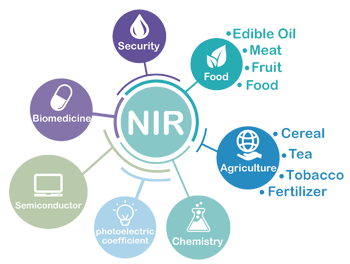
This development in practical terms requires technology that is robust, compact and highly sensitive. With recent innovations, food and system integrators can now rely on consistent and accurate analysis based on miniature near-infrared (NIR) and short-wave infrared (SWIR) spectrometer modules such as those from OtO Photonics’ OtO’s RedBullet (RB), GoldenBullet (GB) and SideWinder (SW) series.
These spectrometers available cover wavelength ranges from 900-2500nm and feature a high-sensitivity, low-noise design engineered specifically for seamless integration into handheld detectors and automated in-line sorting equipment.
Real-World Application: Proven Expertise
Trust in a technology is built on results. The efficacy of these compact spectrometers is already being demonstrated across diverse markets, proving that high-speed analysis does not require a compromise on accuracy.
- Fruit quality: Agricultural technology researchers utilise these modules for the non-destructive measurement of Total Soluble Solids (TSS) and acidity (pH) in fruits such as mangoes and pineapples, establishing reliable models for ripeness and significantly improving sorting efficiency.
- Food safety: Academic teams have employed the SideWinder SW2520 for toxin detection in mussels, effectively strengthening food safety protocols.
- Deep analysis: Laboratories in Europe are leveraging the wide 2500nm spectral range for precise measurements of oil oxidation and protein content, achieving reproducibility that exceeds traditional chemical analysis.
- Ingredient control: The technology is actively deployed for grain moisture measurement and meat protein analysis, supporting precise quality management for food enterprises.
The AP Technologies Advantage: A Consultative Approach and Software Integration
Accessing the hardware is only the first step. The challenge for many manufacturers lies in the integration. Selecting the right spectral range for a specific organic compound or optimising the software interface.
At AP Technologies, we don’t simply supply sensors; we act as a consultative partner, helping manufacturers navigate the technical complexities of NIR spectroscopy. Whether the goal is developing a portable analyser for field testing or an embedded sensor for a manufacturing automation process, we ensure the solution is engineered for the specific environment.
For many customers however, taking delivery of instruments is only the first step. For manufacturers building automated food sorting lines or handheld scanners, the biggest challenge is often the "hidden" engineering cost of software integration.
To eliminate this bottleneck, OtO Photonics modules are supported by a complete software development kit (SDK). The SDK acts as a bridge between the spectrometer and your custom application. Instead of spending months writing code from scratch, your engineers can use the SDK’s pre-built tools to control the module immediately. This allows for:
- Rapid prototyping: Drastically reduce time-to-market by integrating spectral control into your existing software environment quickly.
- Custom algorithms: Focus your R&D effort on the refinements, such as the specific algorithms for mango ripeness or mussel toxin detection, rather than the basic communication protocols.
- Flexible deployment: Whether your system runs on a compact handheld processor or a powerful factory server, the SDK supports flexible integration.
We act as your guide through this process. We help you confirm software compatibility and select the optimal module configuration, ensuring that the transition from a "lab test" to a "shipping product" is as smooth as possible.
Wrap Up
As global supply chains face new challenges in sustainability and safety, the demand for rapid NIR and SWIR spectroscopy will continue to rise. System suppliers who adopt these high-sensitivity optical cores today will define the next generation of food testing solutions. We invite you to discuss your specific sensing requirements with AP Technologies. Together, we can translate complex optical capabilities into a robust commercial advantage for your systems.
|
Contact Martin at AP Technologies to discuss your spectral analysis applications and needs |
Frequently Asked Questions
Q: What is the main advantage of non-destructive spectroscopy over traditional testing?
A: The primary benefit is that it allows for quality verification without damaging the product. Unlike traditional sampling, which is often slow and destructive, spectroscopy provides instant analysis, enabling suppliers to test 100% of their produce rather than just a small sample batch.
Q: What specific food applications can these spectrometers handle? The technology is versatile and currently used for various tasks, such as measuring acidity (pH) and Total Soluble Solids A: (TSS) in fruits such as mangoes and pineapples to determine ripeness. It is also employed for detecting toxins in mussels, analysing protein content in meat, and measuring grain moisture.
Q: Are these devices suitable for harsh environments outside the lab?
A: Yes. The OtO Photonics modules (RedBullet, GoldenBullet, and SideWinder) are specifically engineered with a high-sensitivity, low-noise design for use in field detectors and automated sorting lines. They are robust and compact, making them suitable for challenging environments, such as agricultural fields or wet factory floors.
Q: What wavelengths do the spectrometers cover?
A: These modules cover the Near-Infrared (NIR) and Short-Wave Infrared (SWIR) spectrums, specifically ranging from 900-2500nm. This wide range allows for the precise measurement of organic compounds, including oil oxidation and protein content.
Q: How difficult is it to integrate the software with existing systems?
A: Integration is streamlined using the Software Development Kit (SDK) provided with the modules. This SDK acts as a bridge, allowing engineers to use pre-built tools to control the module immediately rather than writing code from scratch. This approach significantly reduces the time required for prototyping and deployment.