
By Martin Sharratt, Managing Director, AP Technologies
Near-infrared (NIR) and short-wave infrared (SWIR) spectroscopy are moving out of the lab and into production lines, handheld devices, and through farm gates. A new generation of instrumentation, specifically advanced MEMS spectrometers employing “digital light switch” technology via Texas Instruments' DLP® (Digital Light Processing) hardware, is demonstrating that reliable, accurate and consistent spectral analysis is eminently practical within compact, robust form factors and (relatively) low cost.
Design engineers face a significant challenge: integrating NIR and SWIR spectroscopy into systems while optimising size, power, or cost budgets. This article examines how DLP-based spectrometers complement traditional designs to address these challenges.

Key takeaways at a glance
- 7000:1 SNR achieved through single-point InGaAs detectors and DLP photon concentration.
- Minimum exposure of 0.635ms per pattern, allowing for tailored scan speeds.
- Three distinct spectral ranges to suit specific needs: 900 – 1700nm, 1250 – 2050nm, and 1340 – 2280nm.
- Solid-state reliability from a MEMS component and hermetically sealed photodiode
- Firmware-tunable modes: Column, Hadamard, and Slew for optimised performance.
The Architecture of Choice: Linear Arrays vs Digital Light Switches
The traditional approach to NIR or SWIR spectroscopy utilises a linear InGaAs array for operation to 1700nm or an extended-response InGaAs array to increase sensitivity as far as 2500nm. In these Czerny-Turner cavity designs, each pixel of the linear array captures a narrow portion of the spectrum simultaneously. These "snapshot" sensors are the gold-standard for ultra-high-speed requirements with integration times as low as 100µs to produce a full spectrum.
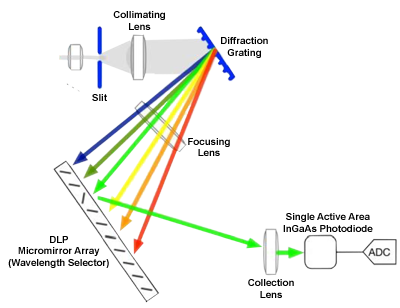
A MEMS-based digital light switch offers a different architecture. Instead of a row of pixels, a design such as OtO Photonics' DragonFly, as shown in the schematic on the left, puts a DLP digital micromirror device (DMD) at the focal plane and uses it as a programmable aperture.
This design allows for the replacement of a costly linear sensor with a high-performance single-point InGaAs photodiode. By using a single active area – which is thermoelectrically cooled for extended SWIR versions – instrument designers can access a lower cost point while still achieving significant performance. This is particularly beneficial at wavelengths beyond 1700nm where the cost benefit of a single detector over an extended-response InGaAs array is most pronounced.
What is DLP® (Digital Light Processing)?
In a DLP-based spectrometer, the optical bench works by directing light onto a grating that spreads the incoming spectrum across the DMD chip. The DMD consists of millions of microscopic mirrors arranged in columns. Under software control, these mirrors act as a programmable gate, selecting a specific segment, or spectral band, of variable width to reflect toward the single-point photodiode. By electronically selecting which columns are "on" or "off", the device determines exactly which part of the spectrum is measured at any given instant.
Targeted Molecular Analysis: 900nm to 2280nm
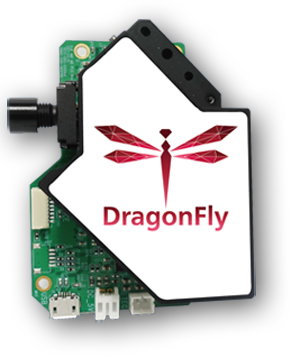
The DragonFly series addresses the "molecular fingerprint" region where overtones and combination bands of C-H, O-H, and N-H bonds dominate. Because different applications require different spectral bands, the technology is delivered in three specific ranges:
- 900 – 1700nm: Ideal for standard NIR applications
- 1250 – 2050nm: Balanced for moisture and protein analysis
- 1340 – 2280nm: Extended SWIR for complex chemical identification.
This technology provides a cost – effective way to bring analysis directly to the sample for applications such as grain, pharmaceutical tablet verification, and polymer identification.
Performance Advantages: SNR, Speed, Reliability
A distinct advantage of the digital light switch architecture is its superior signal-to-noise ratio (SNR). In traditional linear arrays, light is distributed across numerous small pixels. In a DMD-based device like the Dragonfly, it is instead directed entirely to a single-point InGaAs detector. This detector has a substantially larger active area and is optimised exclusively for minimal noise and maximal responsivity within the target spectral band.
- The SNR advantage: Because the DMD transmits only a narrow spectral band at any instant, all photons within that band are concentrated upon a single junction rather than dispersed across multiple pixels. Practical benefits include a 7000:1 SNR, reduced fixed-pattern noise, and simplified electronics.
- Understanding speed: DragonFly achieves a minimum integration time of just 0.635ms per pattern (halogen lamp response). While a full spectral scan typically requires 100 – 200ms, this integration speed can be fast enough, depending on factors such as conveyor speed and required resolution, to support real-time identification tasks. While linear arrays remain the choice for the most demanding high-speed "snapshot" needs, the DragonFly architecture offers a practical balance for many field and industrial uses.
- Reliability and robustness: Mechanical robustness completes the picture. While MEMS technology technically involves micro-mechanical motion, DragonFly is considered a solid-state device in an industrial context. Because the microscopic movement of the mirrors is contained entirely within a hermetically sealed semiconductor package, it eliminates macroscopic moving parts which can suffer wear and alignment drift over time. This confers inherent resistance to shock and vibration during the instrument's service life.
Column, Hadamard, and Slew: Programmable Performance
The DMD’s programmability allows users to choose how they capture data without changing hardware:
| SCAN MODE |
HOW IT WORKS |
PRIMARY BENEFIT |
| Column | Switches one narrow micromirror column at a time. | Simple, intuitive, and high spectral purity. |
| Hadamard | Activates multiple columns in coded patterns. | Reconstructs spectra with a 2 – 7x SNR gain. |
| Slew | Activates multiple columns in coded patterns. | Significantly reduces total scan time for targeted monitoring. |
This flexibility makes the spectrometer a tunable asset. If a process only requires monitoring a specific absorption peak, Slew mode allows the device to ignore irrelevant wavelengths, improving effective throughput.
Accessing High Performance at a Lower Cost
For designers building scientific and industrial instruments, the MEMS-based approach offers an opportunity to engage at a different price point. By utilising a single-point detector, the DragonFly-series provides smaller optical benches, lower detector costs, and point-of-need ruggedness. While linear arrays remain essential for ultra-high-speed requirements, the DLP digital light switch is a significant, practical solution for robust and repeatable sensing in the field.
It is also worth highlighting that extended-response InGaAs linear arrays such as those used in OtO Photonics' own SideWinder-series spectrometers require a relatively large "real estate" of semiconductor wafer. This is exacerbated by the demand for minimal dead, or high noise, pixels with no out-of-specification pixel grouping - all of which drives up cost and limits production capacity. The use of single extended-response photodiodes operating to 2050nm and 2280nm allows DragonFly to address SWIR applications in quantities that would not be sustainable with linear arrays.
Find out more about the DragonFly series to optimise your system's performance and cost-efficiency and visit the product page.
Whether you require programmable flexibility for targeted sensing or the ultra-high-speed capabilities of a classic linear array, OtO Photonics offers a comprehensive range of compact and miniature spectrometers. Access the right technology at the right price point for your system and application and bring laboratory-grade analysis directly to the field.
| To discuss your spectral analysis application and requirements contact Martin at AP Technologies |
Frequently Asked Questions
Q: What is the minimum integration time for Dragonfly spectrometers?
A: The Dragonfly achieves a minimum exposure time of just 0.635ms per pattern. While a full spectral scan typically requires 100-200ms, this integration speed can be fast enough – depending on specific application factors such as conveyor speed and required resolution – to support real-time measurements in industrial and agricultural settings.
Q: How does a single-point detector improve SNR compared to linear arrays?
A: In traditional linear arrays, light is spread across numerous small pixels. The DragonFly instead directs all photons from a specific spectral band onto a single-point InGaAs detector with a substantially larger active area. This concentration delivers a superior 7000:1 SNR and reduces fixed-pattern noise.
Q: Is a MEMS–based device truly robust enough for field use?
A: Yes. Although MEMS involves micro-mechanical motion, the DLP used in DragonFly is considered a solid-state device. The movement is contained within a hermetically sealed semiconductor package, eliminating macroscopic moving parts, that traditionally suffer from wear and alignment drift. This ensures inherent resistance to shock and vibration.
Q: Can one Dragonfly model cover the entire 900 – 2280nm range?
A: No. To ensure optimal performance, the technology is delivered in three specific ranges: 900-1700nm, 1250-2050nm, and 1340-2280nm. This allows instrument designers to access a lower cost point while still achieving significant performance at the specific wavelengths required.
Q: What is the benefit of the Slew scan mode?
A: Slew mode is a programmable option that allows the spectrometer to skip directly to specific regions of interest. By ignoring irrelevant wavelengths and only monitoring specific absorption peaks, it significantly reduces total scan time and improves effective throughput for targeted monitoring.