
By Martin Sharratt, Managing Director, AP Technologies
Biomedical and life science instrument designers have long been challenged by the "impossible" green wavelengths of 561 nm and 594 nm. For decades, accessing these crucial wavelengths for advanced flow cytometry and fluorescence microscopy has meant accepting fundamental compromises between performance and miniaturisation. Our new white paper reveals how a revolutionary breakthrough in semiconductor laser diode architecture offers the potential of transforming instrumentation design.
These wavelengths exist in an optical dead zone – beyond the reach of standard semiconductor laser diodes yet traditionally requiring the bulky, power-hungry solutions of DPSS or OPSL lasers. This constraint has forced engineers into uncomfortable trade-offs precisely when healthcare markets are starting to expect if not demand portability in point-of-care diagnostics.
The Engineering Dilemma
Traditional approaches to generating visible light at these wavelengths have relied on frequency conversion in multi-component systems occupying tens to hundreds of cubic centimetres. Such an approach typically wastes in excess of 60% of input power in the conversion process, creating significant thermal management challenges that directly conflict with the miniaturisation goals of modern biomedical instrument manufacturers.
As a result, development has been constrained by:
- Substantial footprint requirements limiting portability.
- Excessive power consumption affecting battery life and thermal stability.
- Complex optical arrangements increasing assembly costs and failure points.
- Restricted layout flexibility in compact instrument architectures.
A Paradigm Shift in Laser Architecture
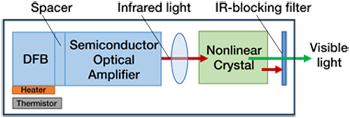 Recent advances in hybrid laser technology now offer a solution to this challenge. By integrating distributed feedback (DFB) seed generation with semiconductor optical amplification and waveguide-based nonlinear conversion, engineers can now access these critical wavelengths in packages under 0.5 cc in volume and 22 x 5.6 x 3.8 mm³ in dimensions.
Furthermore, with no internal thermoelectric cooler and an operating temperature of 20 – 30°C, the demands on system cooling are minimised, further benefiting system miniaturisation and power consumption.
This breakthrough stems from a highly innovative approach to combatting the specific challenges of thermal isolation and spectral control and providing highly efficient frequency conversion. By combining molecular beam epitaxy precision with advanced PPLN crystal technology unprecedented performance density is readily achieved.
Performance That Transforms Design Possibilities
The benefits of this innovation extend beyond simple size reduction. These compact systems deliver:
- Spectral precision: Single-frequency operation with MHz-level linewidth stability enhances detection accuracy in demanding spectral applications.
- Thermal resilience limits wavelength drift to ~0.04 nm/°C, effectively eliminating mode-hopping.
- Flexibility of operation: Continuous wave, high speed modulation and gain-switched picosecond pulsing, ideal for STED microscopy applications.
- Energy Efficiency: At just 8W consumption, these lasers use a fraction of the power required by conventional approaches.
Strategic Implications for UK OEMs
More than incremental improvement, the development of a stable laser diode for deployment at the previously “impossible wavelengths” of 561 nm and 594 nm has the potential to be a genuine game changer in biomedical instrument design. The dramatic reduction in size, power, and complexity constraints allows developers to refocus on core functionality as opposed to managing the limitations of their laser sources.
For organisations developing next-generation cytometers, microscopy systems, or Raman spectrometers, this technology removes traditional barriers to innovation while opening new possibilities for point-of-care and field-deployable instruments.
Engineering Intelligence for Competitive Advantage
Understanding the technical foundations of these advances – from the thermal isolation strategies that preserve spectral stability to the modulation techniques that achieve >30 dB extinction ratios – provides crucial insight for informed design decisions.
The complete technical analysis, including detailed performance data, architectural diagrams, and test data, shows the full potential this technology offers.
Ready to explore how compact visible laser technology can transform your next-generation instrument design? Download the comprehensive white paper for detailed technical specifications, performance data, and comparison with traditional technologies.
.
| To discuss your laser diode application and requirements contact Martin at AP Technologies |