
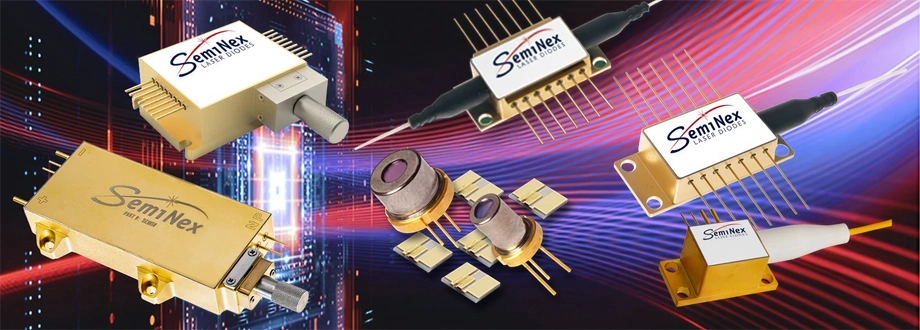


 SemiNex Corporation's Triple Junction laser diode technology uses three monolithic semiconductor laser junctions to produce more than 100 watts of peak power at 1550nm under pulsed operating conditions. Compared with a conventional single-junction laser diode, SemiNex' technology delivers three times the optical power with 1W/A slope efficiency. Its low operating voltage also enables wall-plug efficiency that can be up to twice as high at high drive currents as comparable diodes on the market.

Triple Junction Product Family
SemiNex offers Triple Junction laser diodes in a range of configurations to meet different customer requirements and application needs.
- Aperture widths: 50μm, 95μm, 180μm, and 350μm
- Standard cavity lengths: 1.5mm and 2.5mm
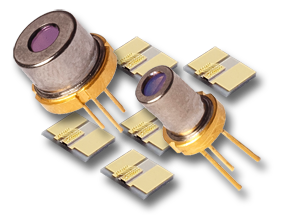
- Packaging and submount options: Chip-on-Carrier, TO9, and TO56
- TO-9 and TO-56 can be supplied with flat window cap (-160) or uncapped
- Integrated microoptics for matched 10°x10° (-140) and Fast Axis Collimated 0.3°x10° (-181) beams
| Part Number |
Aperture Width |
Peak Power (>10ns pulse) |
Peak Power (150ns pulse) |
Operating Voltage |
Beam Angle (Θ┴ / Θ‖) |
|
 |
TO9-264-xxx | 50µm | 25W (25Apk) |
15W (20Apk) |
9V | 28° x 12° |
|
TO9-265-xxx | 95µm | 50W (50Apk) |
35W (40Apk) |
10V | 28° x 12° |
|
TO9-266-xxx | 180µm | 75W (60Apk) |
52W (56Apk) |
10V | 28° x 12° |
|
TO9-267-xxx | 350µm | 100W (100Apk) |
75W (75Apk) |
11V | 28° x 12° |
Applications of Triple Junction Laser Diodes
LiDAR for autonomous vehicles, drones, and industrial applications
Over the past decade, LiDAR manufacturers have generally relied on two laser approaches for time-of-flight systems: 905nm laser diodes and 1550nm fibre lasers. Fibre lasers at 1550nm are often impractical for mass-market deployment because of their size, cost, and complexity. Meanwhile, multi-junction 905nm laser diodes are typically limited to a range of about 100 meters because of eye-safety acceptable emission limits defined by International Electrotechnical Commission (IEC) regulations.
As a result, both approaches involve compromises in order to meet automotive requirements for long-range, eye-safe, and cost-effective LiDAR suitable for high-speed autonomous vehicles and a key challenge has been finding a cost-effective semiconductor laser diode that can deliver high peak power at eye-safe wavelengths for long-range use.
SemiNex' 1550nm Triple Junction technology is the solution to this challenge, providing three times the peak power of a single emitter and so improving resolution and performance in adverse weather while maintaining eye safety. It can operate with pulse widths from 2ns to 150ns and pulse repetition rates from 200kHz to 400kHz with detection ranges of more than 250 meters. Compared with a 905nm laser diode used in automotive LiDAR, it provides:
- 80 times more photons
- 27 times stronger detection
- 3 times longer detection distance
An article discussing the performance of the Triple Juniction technology was published in the November 2021 issue of Laser Focus World, providing benchmark details showing how 1550nm Triple Junction laser diode outperforms 905nm solutions for long-range LiDAR. This article is available as a white paper in the table below, alongside data sheets for the range of lasers.
Range-finding and targeting applications
Infrared lasers are widely used in targeting and range-finding applications. They are especially valuable in laser target designators used with precision-guided munitions because infrared light is not visible to the human eye. For range finding, 1550nm infrared lasers are also commonly preferred because they meet eye-safety requirements.
SemiNex Triple Junction laser diodes deliver very high power for applications where both detection range and eye safety are critical. Compact package options such as TO9 and TO56 support straightforward design-in and drop-in replacement within existing systems.