
By Martin Sharratt, Managing Director, AP Technologies
This article provides an overview of low-light detection techniques and how silicon photomultipliers offer advantages over photomultiplier tubes for some applications. We take a look at the physics and practicalities, helping you decide when a SiPM is the better choice for your system.
Photomultiplier tubes (PMTs) have been the standard technology for detecting low light levels since the mid‑20th century. Their ability to deliver extremely high gain (typically 10⁶ to 10⁸), combined with very low intrinsic noise, has made them the detector of choice for applications ranging from medical imaging such as Positron Emission Tomography (PET), Computed Tomography (CT) and Single Photon Emission Computed Tomography (SPECT), to radiation detection and particle physics. More recently however, advances in solid‑state photodetectors, particularly silicon photomultipliers (SiPMs), have provided engineers and system designers who require compact, robust and easily integrated devices with a compelling alternative.
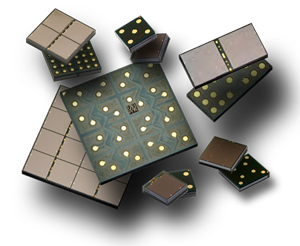
Constructed from two‑dimensional arrays of Geiger‑mode avalanche diodes with individual passive quenching resistors (SPADs), SiPMs provide PMT level gain in a device just a few millimetres across operating with a bias of less than 50V . Because they dispense with vacuum components and dynode chains, SiPMs significantly reduce power, volume and safety requirements. Their viability as an OEM system component is compounded by their solid‑state nature and the fact that this grants immunity to magnetic fields and ensures resilience to mechanical shock. These attributes meant that SiPMs are well suited to compact, portable or magnetically constrained applications.
In this technical blog we explore the operating principles, performance characteristics and practical implications of both technologies, enabling engineers and system designers to choose the detector best aligned to their needs.
Operating Principles
 At the heart of a PMT is a photocathode that emits a photoelectron when struck by a photon. That electron is then accelerated through a chain of dynodes held at progressively higher potentials, typically between 1 and 3 kV, resulting in cascaded secondary emission and a final gain of up to 10⁸. The vacuum tube architecture ensures very low intrinsic noise, but does require a rigid glass envelope, bulky high voltage circuitry and magnetic shielding to prevent performance degradation.
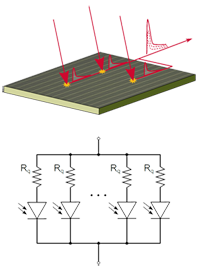
Silicon Photomultipliers adopt a different approach. A SiPM comprises SPAD microcells in the order of hundreds to thousands, arranged in parallel with common anode and cathode. The SiPM is operated at an “overbias” (VOB) or “overvoltage (VOV) above its breakdown voltage (VBR): when a photon triggers a breakdown in one SPAD it produces a uniform charge pulse with gain equivalent to a PMT. This charge creates a voltage drop in the SPAD's quenching resistor, bringing the local bias of the SPAD below the breakdown voltage and returning the SPAD to a stable, charged, condition ready to detect the next photon. The time taken to return to the stable condition is referred to as the "Recharge Time Constant".
The aggregated output current from all fired SPADs is therefore proportional to the number of SPADs fired, and thus photons detected, yet the entire device fits within a few square millimetres and operates with a bias of less than 50 volts. By eliminating the vacuum envelope and dynodes, SiPMs simplify integration and power requirements without compromising performance.
Sensitivity: Photon Detection Efficiency vs Quantum Efficiency
PMT sensitivity is commonly specified as quantum efficiency (QE), the probability that an incident photon will liberate a photoelectron at the photocathode. Typical bialkali PMTs reach peak QE of 35–40 % around 420 nm. Engineers also refer to radiant sensitivity (mA/W) and luminous sensitivity (µA/lm) to characterise photocathode response to power or luminous flux.
In contrast, SiPMs quantify sensitivity with photon detection efficiency (PDE), which multiplies the silicon’s internal QE by the probability of avalanche initiation and the microcell fill factor. Devices, such as Broadcom’s NUV‑MT series achieve up to 63 % PDE at 420 nm and maintain more than 30 % PDE down to 300 nm. In practice, this higher PDE means that more of the available photons are converted into detectable pulses. This is particularly valuable in UV/blue applications such as scintillator based X‑ray and gamma detectors or fluorescence instruments.
Noise Performance and Dynamic Range
 Both PMTs and SiPMs deliver the sensitivity and gain necessary for single photon detection, but they diverge in their noise characteristics and handling of high photon flux. A detector’s dark count rate is the frequency at which it registers doubtful pulses in total darkness, effectively its intrinsic noise floor. Thanks to their vacuum tube design PMTs can exhibit dark counts from a few hertz upwards at room temperature. In contrast, due to thermal generation of carriers in silicon, SiPMs start with higher dark counts, typically hundreds of kilohertz per mm² at room temperature.
Thermoelectric cooling can be deployed to suppress SiPM dark counts to below 100 Hz, restoring a signal‑to‑noise ratio competitive with PMTs. It should be noted however that cooling of SiPMs is rarely necessary and the vast majority of SiPM applications are room temperature and handheld radiation detectors operating in excess of 50°C achieve their specified minimum detectable energy under these conditions.
When photon flux increases, PMTs maintain linearity across multiple orders of magnitude, making them ideal for applications where light levels vary widely. SiPMs, however, have a finite number of SPAD microcells, creating a mechanical limit to the maximum number of photons which can be detected simultaneously. As the number of incident photons increases the likelihood of a photon causing a partially recharged SPAD microcell to discharge becomes higher, resulting in non-linearity as the SiPM approaches saturation. If SiPMs are used, the selection of the appropriate SiPM and optimisation of the operating conditions is recommended.
SiPMs exhibit correlated noise or optical crosstalk, where one avalanche can trigger a neighbouring SPAD. Additionally afterpulsing, where trapped carriers release after a delay, can be an issue. However, in most SiPMs afterpulsing is less than 1%. Both effects grow with overvoltage but can be mitigated through optimised bias control and signal processing algorithms. Crosstalk is also reduced in Broadcom SiPMs by the incorporation of a technology known a "Metal-filled Trench".
Immunity to Magnetic Fields
PMTs suffer performance degradation – gain loss and increased noise – even in modest magnetic fields, for example those generated by electric motors, necessitating complex lightguide assemblies when used in hybrid imaging systems. By contrast, being semiconductor devices, SiPMs are insensitive to magnetic flux and are designed with zero magnetic content, eliminating distortion effects when placed within the high magnetic fields of MRI systems. This property allows direct mounting of SiPMs adjacent to scintillator crystals within MRI magnet bores, enabling true simultaneous PET/MR, CT/MR or SPECT/MR operation. The result is improved timing resolution, often below 200 ps jitter, simplified optical layouts and reduced photon losses.
Integration, Size and Durability
Whilst mechanical shock, vibration and brief exposure to ambient light can damage fragile PMTs, SiPMs’ compact form factor and epoxy encapsulated packages ensures resilience to these environmental hazards.
Their surface mount compatibility allows seamless tiling into large detector arrays or integration into handheld, battery‑powered instruments. Low voltage operation further reduces power supply complexity, making SiPMs particularly attractive for portable radiation monitors, spectroscopic analysers and facilitating innovation in the development of point‑of‑care diagnostic systems.
Comparison Table
|
Parameter |
SiPM |
PMT |
|
Operating Voltage |
35–60 V |
1–3 kV |
|
Spectral Sensitivity |
250–980 nm; 63 % PDE @ 420 nm |
150–1 700 nm; ~ 40 % QE @ 420 nm |
|
Dark Count Rate |
100s kHz/mm² (room temp) <100 Hz when cooled |
Hz–kHz |
|
Dynamic Range |
Limited by SPAD count and recharge time constant. |
Broad linear response |
|
Magnetic Field Sensitivity |
None |
High |
|
Mechanical Robustness |
Solid-state; shock tolerant |
Fragile; vacuum sealed glass |
|
Form Factor |
Compact; surface mount component, arrays |
Bulky; single tube or multi-anode |
Case Study: The Christie, Manchester
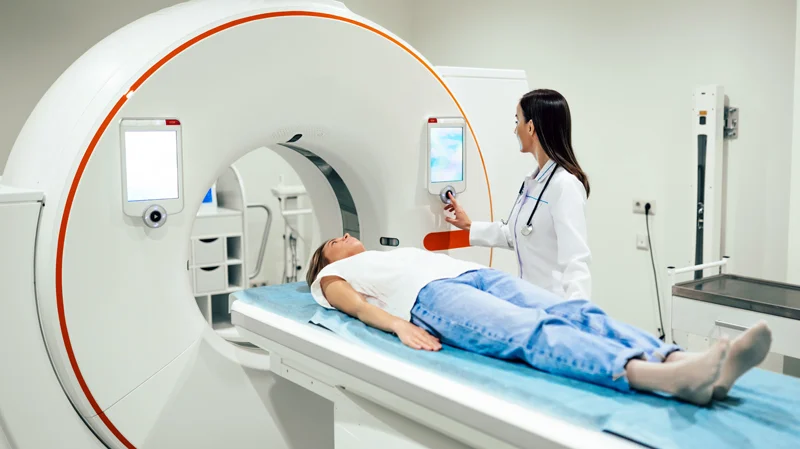 In 2021, The Christie at Manchester University NHS Foundation Trust directly compared its PMT‑based Biograph mCT with the SiPM‑equipped Siemens Biograph Vision 450 digital PET–CT under NEMA NU‑2 2012 protocols. The transition to SiPMs yielded significant performance gains:
- Time‑of‑Flight (TOF) Resolution: Improved from ~560 ps to 215 ps FWHM, sharpening spatial localisation along each line of response from ~8.4 cm to ~3.2 cm.
- System Sensitivity: Nearly doubled, increasing count rates from ~7.5 kcps/MBq to ~15 kcps/MBq.
- Operational Impact: Enabled nearly 50 % reduction in radiotracer activity or approximately 33 % shorter acquisition times. Specifically, a 45.4% reduction in the median scan time for a standard whole-body scan. The scan time decreased from 16 minutes and 0 seconds on the older system to 8 minutes and 44 seconds.
Together, these enhancements supported higher patient throughput and reduced cost per scan, demonstrating the practical advantages of SiPM‑based detection in a clinical setting.
What are the ideal applications for SiPMS?
SiPMs excel in scintillator based radiation detection, where high PDE and fast timing are essential for X‑ray, gamma and neutron dosimetry. In medical imaging, their magnetic immunity and compactness enable integrated PET/MR scanners with improved coincidence timing and simplified optics. Scientific and OEM instruments, from fluorescence microscopes and flow cytometers to LiDAR and time‑of‑flight sensors to gamma and radiation detectors, also benefit from SiPMs’ solid‑state reliability, low voltage operation and potential for array integration.
Wrap up
In our experience, while PMTs continue to offer advantages in applications requiring large sensitive area in combination with lowest noise floor, SiPMs have become the preferred choice for applications demanding compact form factors, low operating bias, magnetic field compatibility and immunity and high UV/blue sensitivity. By aligning detector characteristics with system requirements, namely voltage range, spectral band, dynamic range, environment and footprint, engineers can select the optimal device.
AP Technologies stands ready to advise on SiPM selection, bias/readout electronics design and seamless integration into your next‑generation instrument.
References
Armstrong, I., Julyan, P., et al. (2022). PET Scanner QC and Performance Assessment. Presentation at the Institute of Physics and Engineering in Medicine Conference. Available at: https://www.ipem.ac.uk/media/uelpn3fq/presentations-day-1-v2.pdf.
AFBR-S4NxxPyy4M SiPM Characteristics for PMT Users, an application note from Broadcom: https://docs.broadcom.com/doc/AFBR-S4NxxPyy4M-SiPM-Characteristics-for-PMT-Users.
| To discuss your low-light detection application and requirements contact Martin at AP Technologies |