
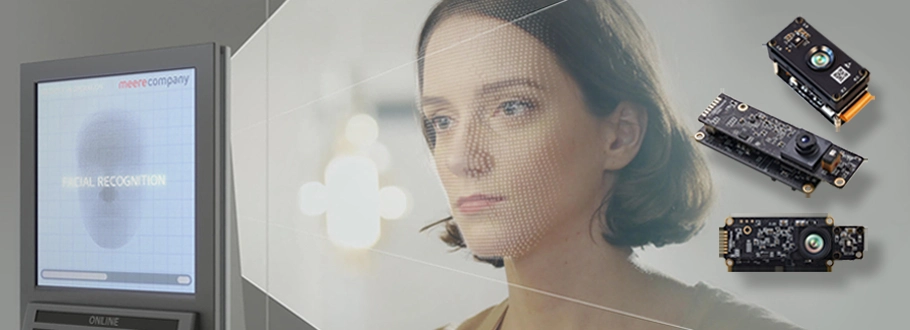


 We are pleased to offer CubeEye indirect time-of-flight (iToF) 3D depth cameras from meerecompany in South Korea
CubeEye's "S-Cube" and "I-Cube" cameras are built around indirect Time‑of‑Flight (iToF) technology, based on modulated light and phase difference measurement to generate high accuracy depth maps. They are positioned for use across robotics, automotive, industrial automation, retail intelligence, medical imaging, and AR/VR applications.
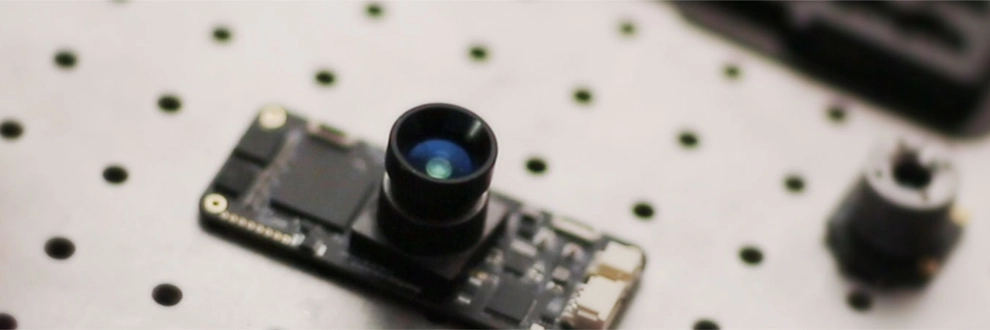
CubeEye 3D depth cameras feature a custom-designed companion chip (MR1000 ASIC or FPGA) that enables efficient thermal management and allows for a compact form factor without compromising performance. The chip is optimised for depth processing, contributing to cost-efficiency and system integration flexibility.
Components of a iToF (Time of Flight) Camera
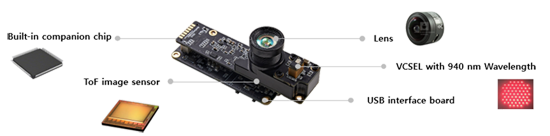
The key components of an indirect time-of-flight 3D depth camera are:-
Control unit, triggers the light pulse sequence from the 940nm Vertical Cavity Surface Emitting Laser (VCSEL) and synchronises the opening/closing of the electronic shutter of the sensor chip. It reads and converts sensor charges and directs them to the built-in companion chip, which carries out the image depth analysis, and the data interface.
VCSEL, near infrared (940nm) VCSEL emits light beyond visible wavelengths (approximately 400-700nm) which is therefore undetectable to the human eye. The VCSEL transmits a continuous modulated signal enabling distance information to be determined indirectly by calculating the phase difference between the transmitted and received signals, hence the terminology "indirect time-of-flight", since the time is calculated rather than directly measured.
Optical lens, used to gather reflected light and image on the optical sensor. Unlike ordinary optical lenses, a band-pass filter is required to ensure that only light with the same wavelength as the illumination light source can enter.
Imaging sensor, the core of TOF camera. The structure of this sensor is similar, but more complex, than that of the typical image sensor. A ToF sensor contains two, or more, shutters to sample reflected light at different times. As a result, the pixel size of TOF chip is much larger than that of ordinary image sensors, generally about 100µm.
Companion Chip, directly calculates the phase change between transmitted and received VCSEL pulses to produce the high accuracy depth map, significantly reducing the processing load on the camera's host system. The depth map is usually a grayscale image, where each value represents the distance between the light reflecting surface and the camera. For better results, data calibration is usually performed.
Principle of Indirect Time-of-Flight Measurement
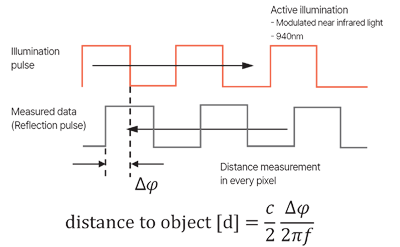
CubeEye 3D depth cameras do not directly measure the time it takes for a pulse of light to travel from the camera to the subject and return to the image sensor, instead, the time of flight is calculated indirectly using the Amplitude Modulated Continuouswave Phase Shift method by measuring the change in a modulated signal's phase.
The CubeEye camera module illuminates an object or a scene with a modulated 940nm VCSEL light source and observes the light reflected from the object. The phase shift (Δφ) between the emitted light and reflected light is measured and translated to distance using the speed of light (c) and the modulation frequency of the VCSEL (f). Using this approach the camera can measure an object’s distance at each pixel.
Output of CubeEye iToF 3D depth cameras
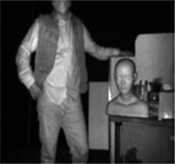
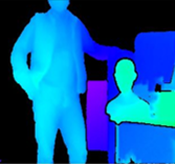
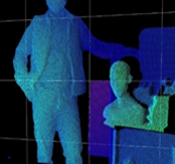
The light signals received by the image sensor are internally processed in two main stages: Depth Calculation and Image Post-Processing. These steps enable CubeEye to generate more accurate and clearer depth data. All processing is performed within the camera module itself, significantly reducing the processing burden of the host system and enabling a faster response to movement than is possible with other 3D cameras. Three data formats are output:-
 |
 |
 |
| Amplitude The strength of the reflected light signal received from a scene. |
Depth Map Colour image where each pixel represents the distance to the object in the scene. |
Point Cloud Set of 3D points that together represent the surface of an object or a scene |
CubeEye 3D iToF depth cameras
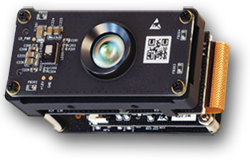
CubeEye cameras are currently offered in a range of two devices.
| I.Cube I200D – Sunlight robust, long range ToF camera | S.Cube S111D – True VGA high accuracy ToF camera |
|
|
For more information on the CubeEye range of iToF 3D depth cameras please use the links or Contact Us to discuss your application.