
By Martin Sharratt, Managing Director, AP Technologies
The requirements for modern sensing systems – whether in automotive lidar, industrial automation or aerospace – are becoming increasingly stringent. Engineers are frequently tasked with detecting lower signal levels over longer ranges while maintaining high data integrity.
 To address these technical challenges, Opto Diode Corporation (ODC) has introduced a new series of avalanche photodiodes (APDs), available through AP Technologies. These detectors are engineered to provide high gain and low noise across the visible and Short-Wave Infrared (SWIR) spectrum, offering a practical solution for applications where standard PIN photodiodes may lack the necessary sensitivity.
Key Highlights
- New range of avalanche photodiodes (APDs) from ODC, featuring InGaAs and silicon technology.
- Three specific models optimise performance for 905nm, 1064nm and 1550nm wavelengths.
- High-speed Time-of-Flight applications supported by the ODD-APD-002 (905nm) featuring a 0.5ns rise time and low capacitance (~1.2pF).
- High quantum efficiency (~1.0 A/W) for eye-safe lidar systems utilising InGaAs technology from the ODD-APD-001 (1550nm).
- Ruggedised for harsh environments with hermetically sealed TO-46 packages and tested for operation between -45°C and +85°C.
- Available customisations include integrated optical filters and varying active area sizes.
The Technical Case for APDs
In many sensing applications, the return signal from a target is attenuated significantly due to distance or low reflectivity. APDs address this by providing internal gain, overcoming the limitations of standard photodiodes which, while effective for higher light levels, often require high-gain external amplification that can introduce noise and limit bandwidth when dealing with weak signals.
The new devices from Opto Diode offer gain values up to 100x while maintaining low excess noise and high linearity. This internal amplification improves the signal-to-noise ratio, which is a significant factor for system designers in extending the detection range and accuracy of a system.
Optimised Solutions for 905nm Industrial Lidar
The use of laser diodes at 905nm remains a standard for industrial and commercial lidar due to the availability of cost-effective laser sources and silicon detectors. However, the performance of the detector is often the limiting factor in the system’s ability to detect and distinguish objects quickly and accurately.
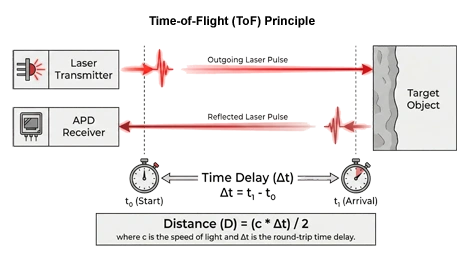 The ODD-APD-002 is a silicon APD specifically optimised for 905nm. It features a 500µm active area and delivers a responsivity of approximately 0.55A/W at 905nm (at Gain=1) A key parameter for engineers working on Time-of-Flight (ToF) systems is the speed of response. This device is engineered with a low capacitance of approximately 1.2pF, which allows for sub-nanosecond rise times, typically 0.5ns.
This fast response is necessary for high-resolution ranging, where the timing of the return pulse must be measured with extreme precision. Furthermore, the device typically exhibits a dark current of 0.4nA (at M=100), which helps to minimise the noise floor and improve the detection of faint signals from low-reflectivity objects. These characteristics make the ODD-APD-002 suitable for obstacle detection, autonomous mobile robots (AMRs) and drone-based navigation systems where reliable object profiling is required.
Precision at 1064nm for Medical and Manufacturing
Applications in the medical and industrial manufacturing sectors often utilise the 1064nm wavelength, commonly associated with Nd:YAG lasers. Standard silicon detectors often have reduced sensitivity at this longer wavelength compared to the visible spectrum, which can limit system performance.
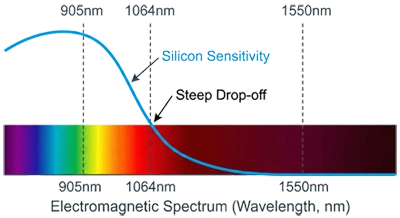 The ODD-APD-003 is designed to address this specific requirement. As with the 002 model, it features a 500µm active area but is optimised for performance at 1064nm. It offers a responsivity of 0.36A/W at this wavelength and a rise time of 2.0ns.
Reliability is often the primary concern in continuously operating production lines or clinical environments. The ODD-APD-003 is characterised for high breakdown stability, ensuring consistent gain characteristics even in variable environments. This makes it an appropriate choice for laser beam monitoring and industrial alignment systems, as well as medical applications such as dermatological lasers, ophthalmological surgery and diagnostic imaging. The device supports precise measurement, providing the data integrity needed for critical process control and diagnostic tasks.
Extending Reach with 1550nm InGaAs Technology
For long-range scanning, eye safety regulations limit the optical power that can be emitted at 905nm or 1064nm. The 1550nm wavelength allows for higher pulse powers while maintaining eye safety, making it the preferred choice for long-range atmospheric and topographic lidar. Silicon is not sensitive at this wavelength, requiring the use of alternative materials.
The ODD-APD-001 utilises Indium Gallium Arsenide (InGaAs) technology to cover the spectral range from 900nm to 1700nm. It features a 200µm active area and is capable of high quantum efficiency, with a responsivity of 1.0A/W at 1550nm. The “001” can also be used for 1064nm, allowing system designers to optimise their choice between silicon and InGaAs technologies.
With a rise time of 0.3ns, the ODD-APD-001 offers GHz-class bandwidth. This high speed, combined with low excess noise, allows for fine resolution 3D mapping even in adverse weather conditions, such as fog or dust, where signal scattering can be problematic. This device enables engineers to design systems that can penetrate atmospheric obscurants more effectively than shorter wavelength alternatives, supporting applications in mining topography, agricultural surveying and environmental monitoring.
Reliability in Harsh Environments
Detectors used in robotics, heavy industry or factory automation must endure conditions far more aggressive than those found in a laboratory. Opto Diode manufactures these APDs in its California wafer fabrication facility, allowing for vertical integration and strict quality control.
The devices are packaged in hermetically sealed TO-46 headers. This packaging protects the active area from moisture and contamination, which is essential for long-term stability. The detectors are tested to operate across a temperature range of -45°C to +85°C. This temperature tolerance ensures that the specified parameters, such as gain and dark current, remain stable whether the device is deployed in a sub-zero mining environment or a hot industrial plant.
Integration and Customisation
While the standard specifications of the ODD-APD series cover a broad range of applications, specific system architectures may require tailored solutions. To address this, AP Technologies collaborates with system designers to identify and develop the necessary custom configurations.
Detectors can be supplied with integrated optical filters. This is particularly useful for lidar systems operating in daylight, where solar background radiation can saturate the detector. A bandpass filter restricts the incoming light to the laser wavelength, significantly improving the signal-to-noise ratio.
Additionally, variations in active area size and the option for combined APD-preamplifier assemblies are available. Integrating the preamplifier directly with the APD can further reduce noise pickup and simplify the electronic design for the system integrator.
Summary
The release of the ODD-APD-001, 002 and 003 provides engineers with a set of detectors targeted at the most common lidar and sensing wavelengths. By offering optimised performance at 905nm, 1064nm and 1550nm, these devices support a wide array of applications, ranging from autonomous robotics and environmental monitoring to industrial process control and precision medical analysis.
The combination of internal gain, high speed and rugged packaging allows these APDs to deliver consistent data in challenging operating environments. For developers looking to improve the range and precision of their optical systems, these new devices offer a dependable and high-performance solution.
For detailed datasheets, visit the avalanche photodiode product family page, or contact us to discuss your application.
|
Contact Martin at AP Technologies to discuss |
Frequently Asked Questions
Q: Why should I choose an avalanche photodiode (APD) over a standard PIN photodiode?
A: APDs are ideal for applications where the return signal is weak due to distance or low reflectivity. Unlike standard PIN photodiodes, APDs provide internal gain (up to 100x), which improves the signal-to-noise ratio without introducing the noise associated with high-gain external amplification.
Q: Which wavelength is best suited for long-range lidar applications?
A: The 1550nm wavelength is generally preferred for long-range scanning. It allows for higher optical pulse powers while adhering to eye safety regulations, which restrict power output at shorter wavelengths like 905nm or 1064nm. The ODD-APD-001 is specifically optimised for this range.
Q: Can these APDs be customised for specific system requirements?
A: Yes. AP Technologies collaborates with designers to implement custom configurations. Common customisations include varying active area sizes, combined APD-preamplifier assemblies, and integrated optical filters to block solar background radiation.
Q: Are these detectors suitable for outdoor or harsh industrial environments?
A: Yes. The detectors are packaged in hermetically sealed TO-46 headers to protect against moisture and contamination. They are tested to operate stably across a temperature range of -45°C to +85°C, making them suitable for environments ranging from sub-zero surveys to hot industrial plants.
Q: What is the benefit of using 1064nm in medical applications?
A: The 1064nm wavelength penetrates deeper into tissue than visible light, making it effective for applications such as dermatological laser treatments and ophthalmological surgery. The ODD-APD-003 is optimised for this wavelength, offering higher sensitivity than standard silicon detectors.