
By Martin Sharratt, Managing Director, AP Technologies
Accurate ultraviolet light measurement is fundamental to applications from industrial laser systems to environmental monitoring. However, a significant engineering challenge lies in the fact that standard silicon photodiodes are vulnerable to the very light they are designed to measure. This exposure to high-energy UV radiation causes a progressive degradation of the sensor, leading to inaccurate readings and eventual performance collapse. The problem is particularly acute with modern, high-power UV sources, such as excimer lasers and new high-efficiency UV-C LEDs. Their use with a traditional photodiode accelerates this failure process dramatically.
This article explains this degradation process and details the radiation-hard photodiode design required for achieving stable, reliable, long-term measurement in the most demanding UV environments.
- The problem: High-energy UV light, particularly from high-power sources, damages the protective surface of standard photodiodes, causing a rapid collapse in performance
- The solution: This article explains this degradation process and details the radiation-hard photodiode technology required for achieving stable, reliable, long-term measurements in the most demanding UV environments.
- The result: Pairing Opto Diode UVG photodiodes with any UV source – from high-power lasers to low-power LEDs – creates a highly reliable analytical system built for longevity and accuracy.
Why do standard photodiodes fail under intense UV exposure?
At the heart of the issue is the high energy of UV photons. There is an inverse relationship between a photon's wavelength and its energy: the shorter the wavelength, the higher the energy. When these high-energy photons strike a standard silicon photodiode, problems arise not within the active photodiode junction itself, but at its protective surface.
The silicon dioxide (SiO₂) passivation layer absorbs the intense UV-C radiation. Under this constant bombardment, this layer begins to darken or yellow – much as plastic degrades in sunlight. This damaged passivation layer then blocks subsequent light from reaching the sensor, permanently reducing its responsivity and ability to provide accurate measurements.
While this has always been a known issue, it has become a critical failure point with the advent of modern UV sources. High-power excimer lasers deliver extremely high radiation doses, while the high efficiency of new deep UV-C LEDs delivers a damaging dose far more quickly than older, less efficient sources. In both cases, this turns a slow degradation process into a rapid performance collapse, making standard photodiodes unsuitable for any application that requires long-term reliability.
The solution: stability by design with the UVG series
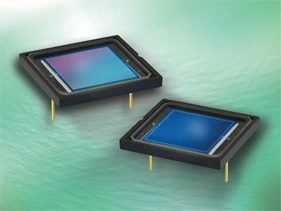
Opto Diode's UVG series photodiodes have been developed to overcome these specific challenges.
They are engineered to provide superior performance and stability in the deep UV spectrum, down as low as 190nm. Their unique design ensures they can withstand long-term exposure to high-energy UV radiation without suffering the degradation seen with standard components.
Key features include:
- Proven hardness against high-power lasers: The UVG series features a super-hard, radiation-hard oxynitride protective window. This design has been proven to provide extreme stability, showing less than 2% responsivity degradation even after exposure to the exceptionally high doses delivered by UV lasers – including tens of kilojoules/cm² from a 193nm ArF excimer laser.
- Absolute stability with UV-C LEDs: Because of their unique technology, these photodiodes are able to withstand the extreme conditions of high-power UV lasers. Alternatively, their long-term stability when paired with lower-power sources, such as 230nm far UV-C LEDs, is absolute. This ensures measurements remain consistent and reliable over thousands of hours.
- Exceptional UV responsivity: The UVG series provides high sensitivity in the 190-400nm range, ensuring precise and accurate measurements right across the UV spectrum.
- High internal quantum efficiency: With a 100% internal quantum efficiency across the 310nm to 640nm waveband, every photon that enters the active region is converted into a measurable current, maximising the signal.
The clear choice for critical applications
The exceptional stability of the UVG series makes it the obvious choice for any application where measurement accuracy and longevity are fundamental requirements. This proven technical performance provides confidence across a wide range of demanding analytical tasks.
Applications where this technology excels include:
- UV laser power monitoring: Providing stable and reliable feedback for industrial and scientific laser systems.
- Analytical instrumentation: For applications using UV-C LEDs such as water quality monitoring to detect nitrate (NO₃) or gas detection of compounds like nitric oxide (NO).
- Analytical spectroscopy: Detecting a wide range of chemical compounds through absorption spectroscopy.
Expert Guidance for Your Application
Selecting the right optical components is a significant decision, especially when working with demanding UV applications, from high-power lasers to the latest deep UV LEDs. As your technical partner, AP Technologies is able to help you navigate the complexities of component selection to develop more competitive and reliable laser or instrumentation systems. Having helped many customers overcome similar challenges, we have the specialist knowledge to help you.
The Opto Diode UVG series is the enabling component that solves the critical stability challenge posed by UV light sources. To secure the long-term performance your instruments demand, visit the UVG product page for datasheets or contact us to discuss your application and gain a technical edge.
|
Contact Martin at AP Technologies to discuss UVG photodiodes and UV degradation resistance |
Frequently Asked Questions
Q. How much more stable is the UVG series compared to a standard photodiode?
The stability is significantly greater. The UVG series shows less than 2% responsivity degradation even after exposure to the exceptionally high radiation doses delivered by UV lasers. In contrast, standard photodiodes can suffer a rapid performance collapse under modern UV sources.
Q. What makes the UVG series so resistant to UV damage?
The key is its protective window. Standard photodiodes typically use a silicon dioxide (SiO₂) layer, which darkens and degrades under constant UV bombardment. The UVG series uses a super-hard, radiation-hard oxynitride protective window that is specifically engineered to withstand long-term exposure to high-energy UV radiation without degrading.
Q. Are these photodiodes only suitable for high-power lasers?
No, they are ideal for a wide range of UV sources. Because they are engineered to withstand the extreme conditions of high-power UV lasers, their long-term stability when paired with lower-power sources – such as 230nm far UV-C LEDs – is absolute. This makes them a reliable choice for everything from high-power industrial systems to sensitive analytical instruments.
Q. What is the operational wavelength range for the UVG series?
The UVG series is engineered to provide high sensitivity and superior performance across the deep UV spectrum. It ensures precise and accurate measurements in the 190nm to 400nm range.
Q. Why is having 100% internal quantum efficiency important?
A 100% internal quantum efficiency means that every photon entering the photodiode's active region is successfully converted into a measurable electrical current. For the UVG series, this is true across the 310nm to 640nm waveband, maximising the signal to ensure the highest possible measurement accuracy and precision.