

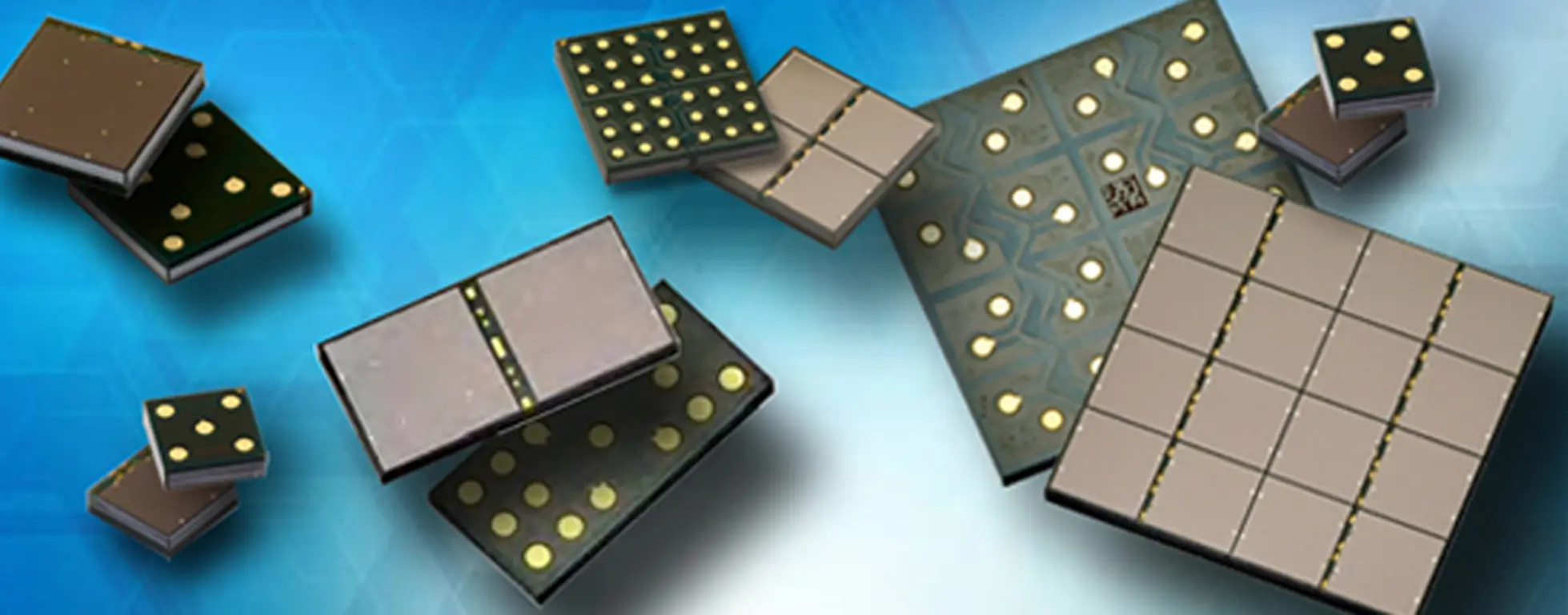
When evaluating silicon photomultipliers (SiPMs) for your system design, it’s important to consider key performance parameters. Noise effects are a major consideration since it can have a significant impact on device performance, accuracy, and suitability for various detection applications.
Noise in a silicon photomultipliers can be considered as four distinct characteristics:-
- Dark count rate
- Optical crosstalk
- Afterpulsing
- Dark current
Dark Count Rate
Spontaneous breakdown of a Geiger-mode single photon avalanche diode (SPAD) triggered by thermally generated electrons will release the same charge as when a photon is detected. These breakdowns are termed "dark counts" and are indistinguishable from actual photon counts. The frequency of these events is termed the "dark count rate" (DCR) and the sum of all of the dark counts generates the "dark current" of a SiPM.
Two factors influence the DCR for a given SiPM, the overvoltage and the temperature.
- Increasing overbias will increase the breakdown probability and therefore the DCR.
- Increasing temperature will increase the carrier density in silicon.
Optical Crosstalk
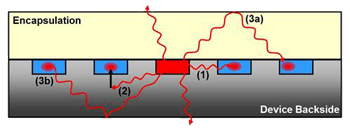
During the Geiger discharge of a SPAD a small number of secondary photons (450nm-1600nm) are created during the electron avalanche. These secondary photons have the potential to cause Geiger discharge of surrounding microcells via three mechanisms:
(1) Directly to a neighbouring cell, known as "direct optical crosstalk". Typically, this is by far the dominant contributor to DCR in unpackaged SiPMs. However, a key feature of Broadcom NUV-MT SiPMs is the deep Metal-filled Trench (hence the "MT" designation) between the individual microcells which provides optical isolation. Direct optical crosstalk is significantly suppressed by the trench – unpackaged NUV-MT series SiPMs exhibit only ~1% direct optical crosstalk. The deeper the trench the more significantly it can reduce delayed optical crosstalk.
(2) A secondary photon is able to generate an electron-hole-pair close to a neighbouring cell. The carriers can diffuse to the microcell and cause their discharge, known as "delayed optical crosstalk". Delayed optical crosstalk is considered almost negligible in SiPMs supplied by Broadcom.
(3a, b) Secondary photons can be reflected at one of the various interfaces (i.e. package boundary or SiPM backside) and reach a neighbouring cell via an indirect path, known as "indirect optical cross talk" and is by far the most significant source of crosstalk in Broadcom NUV-MT SiPMs.
It should be noted that optical crosstalk probability increases with overvoltage.
It can be seen that optical crosstalk has the potential to artificially increase the perceived photon detection efficiency of a SiPM - if crosstalk were 100% then each detected photon would have an associated crosstalk event giving the impression two photons were detected. With this in mind all photon detection efficiency (PDE) data supplied for Broadcom SiPMs excludes the effects of crosstalk and afterpulsing.
Afterpulsing
During the microcell's breakdown and avalanche process, charge carriers can become trapped and then released with a delay of up to several µs.
Correlated Noise
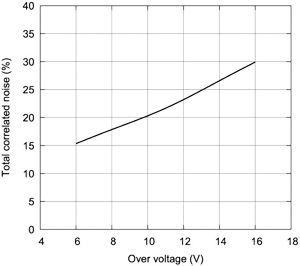
Correlated noise is the combined effect of the optical crosstalk and afterpulsing and in the case of Broadcom's SiPMs is dominated by the crosstalk. The graph below demonstrates the correlated noise performance of Broadcom's NUV-MT SiPM technology:
Dark Current
From the above it can be seen that the dark current of a SiPM, whilst dominated by the DCR, is also influenced by the crosstalk and afterpulsing which are also overbias-dependent. It should also be noted that the gain of an SiPM has a positive overbias coefficient meaning that as the overbias increases the gain applied to the DCR gets higher.
For users of SiPMs it is particularly important that the increase in dark current with temperature is predictable and uniform and does not exhibit any "runaway" characteristics. The plot below provides detailed dark current versus bias voltage curves for a single 6mm channel of the AFBR-S4N66P024M 2x1 array from -20°C to +60°C between 0V and >50V bias.
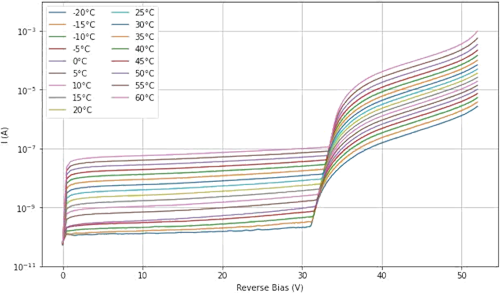
- The gradual increase of the dark current with increasing Temperature for any given bias voltage is clearly seen.
- The rapid increase of the dark current at the breakdown voltage is also evident.
-
- Dark current is close to linear in the typical 40-50V operating range.
Broadcom have produced a number of helpful application notes including NUV-MT Performance Correlation which discusses the relationships between crosstalk vs. gain; DCR as a function of gain and crosstalk and PDE as a function of crosstalk, DCR and gain. This and other application notes can be accessed below.
 |
Broadcom's SiPM Family overview |
|
Product Brief, NUV-MT SiPM range |
|
A Brief Introduction to SiPMs |
|
Working with Broadcom SiPMs |
|
SiPM Characteristics for PMT Users |
|
NUV-MT Performance Correlation |
|
NUV-MT Single-Photon Measurements |
|
SiPM Characteristics for PMT Users |
For further information relating to SiPM technology please visit pages in the Support section using the links in this article and on the right hand side of this page.
Please contact us if you have any questions regarding SiPMs, their applications and specifications.
