

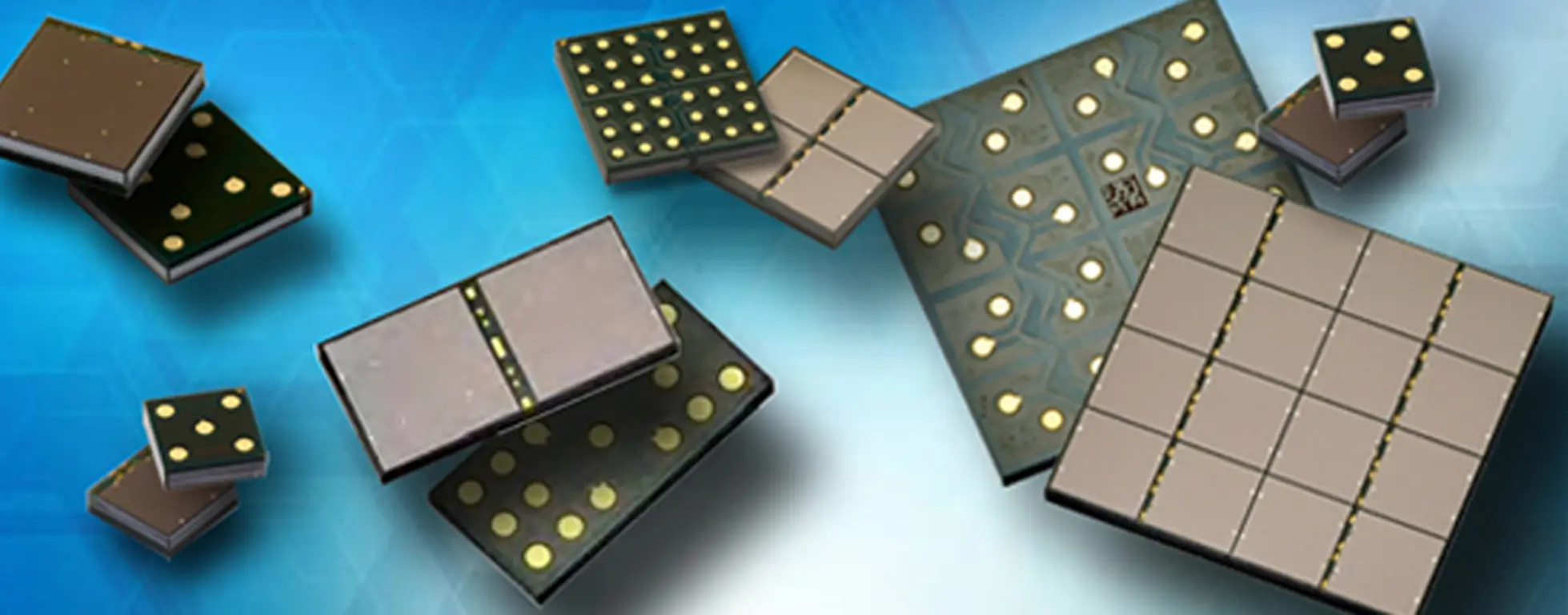
Silicon Photomultipliers (SiPMs) are highly sensitive detectors capable of converting a single photon into a measurable signal. Fundamental to gaining an understanding of SiPM effectiveness is becoming familiar with the combination of factors which influence the photon detection efficiency (PDE).
This article outlines the key performance parameters of SiPMS in this context.
Since the "microcells" or "SPADs" (single photon avalanche diodes) which make up the SiPM comprise a micro-APD together with a quenching resistor, interconnecting circuitry and the trenches between the microcells it can be seen that the quantum efficiency (QE) of the micro-APD itself is only one aspect of the ability of the SiPM to detect photons. The equation for PDE is shown below:
| PDE(λ, V) = QE (λ) • PTrigger (V) • ε | ||||
|
Quantum efficiency (QE): efficiency of conversion process of a photon into an electron-hole pair in the active region of the SPAD Geiger efficiency (PTrigger): probability that the generated electron-hole pair triggers a Geiger breakdown in the SPAD Geometric efficiency (ε): ratio of total active region of the SPADs and SiPM "active area" Wavelength (λ) Bias Voltage (V) |
Note that whilst the geometric efficiency (ε) of the SPAD is fixed by the design, quantum efficiency (QE) is wavelength-related due to the absorption characteristics of silicon and geiger efficiency (PTrigger) increases with voltage.
Hence the PDE of SiPMs depends on two parameters, the applied overbias (voltage above breakdown) and the wavelength of the incoming photon – as a result PDE curves for SiPMs are shown with the applied Overbias.
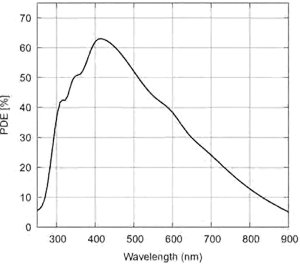 The large 40µm SPAD pitch and efficient design of Broadcom metal-filled trench (NUV-MT) SiPMs produces a high geometric fill factor of micro-APD active area (ε). In combination with high QE this produces SiPMs with industry leading PDE of 63% (12V overbias) at 420nm, as shown.
The latest NUV-MT SiPMs from Broadcome are optimised for blue light making them ideally suited to applications utilising scintillator materials such as LSO, LYSO, NaI:Tl, CsI, GSO, Anthracen, etc.
The equation indicates that the PDE of an SiPM increases as a positive coefficient of the applied bias (V) and also that this is a result of the Geiger efficiency's positive Voltage coefficient. Geiger efficiency increases with increasing Overbias until it reaches its maximum, i.e. saturation, level.
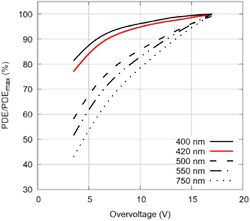 This plot shows PDE at increasing overvoltage for the NUV-MT technology at wavelengths from 400-750nm and demonstrates that all wavelengths reach their maximum PDE at ~17V overbias.
It is also clear that the increase in PDE relative to the maximum is far steeper for longer wavelengths whereas shorter wavelengths are closer to their maximum at much lower overbias. This means that for shorter wavelengths the overbias can be decreased to reduce noise such a crosstalk and DCR while maintaining a high PDE.
Bear in mind that dark count rate, gain, crosstalk and afterpulsing also increase with increasing overvoltage meaning noise, saturation and linearity are all affected. Therefore it should not be assumed that higher overbias = higher PDE = optimum performance in any given application. The correlation between PDE, crosstalk probability, dark count rate, gain and overbias is discussed in Broadcom's application note NUV-MT Performance Correlation. We also explain the factors to consider relating to SiPM noise in our Support article Silicon Photomultiplier Noise.
When considering SiPMs as an alternative to vacuum photomultiplier tubes (PMTs) users may be more familiar with "radiant sensitivity". Broadcom have also produced a helpful application note SiPM Characteristics for PMT Users which discusses PDE and Radiant Sensitivity.
 |
Broadcom's SiPM Family overview |
|
Product Brief, NUV-MT SiPM range |
|
A Brief Introduction to SiPMs |
|
Working with Broadcom SiPMs |
|
SiPM Characteristics for PMT Users |
|
NUV-MT Performance Correlation |
|
NUV-MT Single-Photon Measurements |
|
SiPM Characteristics for PMT Users |
For more detail and technical backgrounds on the product types we supply, please visit the Support pages using the links in this article and on the right hand side of this page.
