
By Martin Sharratt, Managing Director, AP Technologies
Although LEDs were invented almost a century ago and have been in commercial use for over 60 years, until now, their fabrication for deployment in the UV has proved challenging. Traditional highly Al-doped bulk crystal AlGaN techniques have been the basis for most LEDs used at these wavelengths. However, semiconductors manufactured in this way face fundamental limitations that restrict their effectiveness. These limitations are particularly significant in the deep UV, below 275nm, for applications such as sterilisation, water purification and in medical devices.
Understanding SPSL Technology
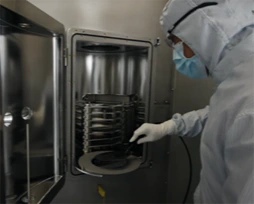
The use of short-period superlattice (SPSL, also known as “digital alloy”) technology for UV LED fabrication presents significant advantages for both system developers and the LED manufacturer. SPSL’s use of alternating layers of semiconductor materials with thicknesses of just molecules, creates improved quantum effects compared to designs relying on conventional AlGaN fabrication methods. The SPSL architectural approach enhances electron-hole recombination efficiency, reduces structural defects in the crystal lattice and optimises light emission at targeted wavelengths.
Both SPSL and bulk crystal techniques are based on the same elements – Aluminium, Gallium and Nitrogen. In the case of conventional bulk AlGaN crystal devices, difficult-to-achieve high Aluminium concentrations are required to manufacture LEDs in the far UV-range below 240 nm. This leads to low production yield and thus high production cost in combination with low efficiency.
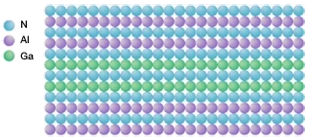 To overcome this, SPSL uses monolayered deposition of AlN and GaN. Discrete layers of N, Al and Ga atoms are deposited to produce an alternating AlN (barrier) and GaN (Quantum Well) structure. In this structure, wavelength is a function of the AlN and GaN layer thickness, which is controlled by the deposition time.
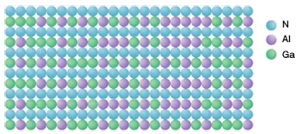
In comparison, the active region of conventional bulk crystal semiconductors are prone to segregation and wavelength control requires the tuning of Al to Ga species ratio which becomes increasingly hard to control as higher Al doping is required to achieve shorter wavelengths.
The simpler SPSL process results in more accurate, consistent and dependable component performance.
SPSL Performance Advantages Over AlGaN
In addition to reducing the difficulty of manufacturing shorter wavelengths the SPSL structure greatly improves the performance of LEDs at these shorter wavelengths.

Conventional bulk crystal AlGaN materials with high Al doping exhibit very poor light extraction as the generated photons transition from vertical (TE) to lateral (TM), meaning only a small percentage of the light is emitted vertically from the semiconductor. Package design can be used to try to overcome this fundamental limitation, adding to complexity and cost with very limited success.
 However, since the emission from an SPSL LED is governed by thickness and period rather than composition, the emissions originating from the GaN part of the SPSL remain mostly vertical through the whole spectrum, allowing high power to be maintained even at ultra-short wavelengths.

Silanna UV introduced a new generation of 235nm LED at the Photonics West exhibition is January 2025. The headline 2% wall plug efficiency (WPE) equates to a typical output of 3mW at 20mA.
The longer product lifetimes of SPSL LEDs is also significant. The reduced crystalline defect density of an SPSL semiconductor ensures more a reliable crystal lattice and consequentially LEDs provide consistent performance over prolonged usage periods, an attribute especially valuable in critical applications requiring continuous operation.
Precision wavelength targeting is another advantage SPSL offers over conventional AlGaN. The accuracy of LEDs fabricated in this way is of particular value for water purification applications at far UV wavelengths 230–265nm. The fact that SPSL LEDs can be relied on to operate at precise wavelengths ensures optimal photobiological UV emission effectiveness within the germicidal spectrum. Less precise LEDs have to operate over a broader wavelength range and so expend more energy on non-contributory wavelengths.
Engineering Implementation Benefits
For anyone developing next-generation UV systems, SPSL technology offers practical advantages and is a potential game-changer in system design and performance:
- Simplified system design: The higher efficiency of SPSL LEDs allows for reduced cooling requirements compared to conventional components, making way for more compact and cost-effective thermal management solutions.
- Enhanced performance: For water purification systems and sterilisation equipment, an improvement in quantum efficiency translates directly to better rates of disinfection and lower power consumption, enabling both performance enhancement and increased energy efficiency. The quantum efficiency from SPSL LEDs also shows an impressive 35-45% improvement output with equivalent power inputs.
- Compatibility: SPSL-based LED components work with standard driver electronics and optical components. With no modification necessary integration into established design architectures is straightforward.
See what Silanna UV say about their technology in this video.
Applications Impact
The technical advancements provided by SPSL technology translate directly to enhanced capabilities across multiple fields of application. Medical device sterilisation systems benefit from shorter operating cycle times, so improving efficiency throughput in critical healthcare environments. Water purification units achieve higher treatment efficiency with significantly reduced energy consumption.
Industrial curing processes can become more precise with the optimisation of spectral output, resulting in improvements in material properties and reductions in processing times. Analytical instruments incorporating SPSL-based light sources demonstrate enhanced detection sensitivity, expanding the range of measurable analytes at lower concentration thresholds.
UV LEDs
AP Technologies represents Silanna UV. For product information on Silanna UV Light Emitting Diodes at 235nm and 255nm visit the UVC LED product page. You can also read more about short-period superlattice (SPSL) technology in this short technical feature.