






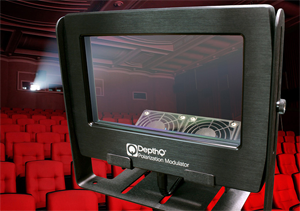
 We supply liquid crystal based Fast Polarisation Modulator (FPM) devices from LC-Tec. The FPM-series are a range of liquid crystal (LC)-based optical components which control light polarisation by an externally applied drive voltage.
Compared to conventional modulators/rotators, electro-optical LC modulators contain no moving parts, are completely vibration-free, and have a small footprint.
Most modulator models consist of a an liquid crystal cell together with a polariser. Applying the drive voltage reorients the birefringent LC molecules, changing the phase retardation of light passing through the LC cell. This results in a change in polarisation of light passing through the full modulator structure.
In order to meet a wide range of requirements for various applications, LC-Tec offer both standard and high speed FPM models possessing different electro-optical properties:-
FPM(L): Offers high contrast between two orthogonal linear polarisation output states even at moderate drive voltage amplitude together with fast switching from polarisation altering to non-altering state. It is suitable for customers seeking a general purpose modulator without having extreme requirements for fast switching.
X-FPM(L): The fastest single-cell modulator which differs from the FPM(L) model by extra-fast switching speeds, both response and relaxation. This modulator should be considered for applications in which high-frequency operation between two linear polarisation states is desired.
The standard models described above are available in the 2" x 2" format without MOQ and with short lead times. Other sizes detailed on LC-Tec's data sheets are available with 200 piece MOQ and custom sizes, shapes and array formats can also be developed with NRE and tooling charges quoted on a case-by-case basis where the potential is in the range of 1000s per year over several years.
 |
FPM & VPR overview |
|
FPM(L) - Standard Polarisation Modulator |
|
X-FPM(L) - Fast switching between two states |
|
LCC-230 LC-FOS controller manual |
For customers not finding their required modulator properties, other designs can be produced where annual quantities meet the criteria of 1000+ per year over a period of several years.