
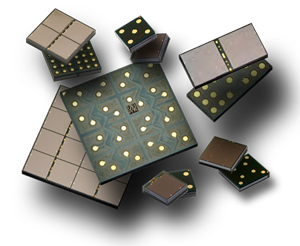
We are pleased to announce the release of Broadcom's new generation of high performance Silicon Photomultipliers (SiPMs), the NUV-MT-Series.
Silicon photomultipliers are a fast and sensitive solution to the challenge of detecting, timing and measuring extremely weak light. NUV-MT SiPMs take extreme low light level detection, accuracy and efficiency to a new level.
The first products to be released are 4mm and 6mm active area surface mount components along with three surface mount arrays – 4 x 4 and 2 x 2 4mm pitch devices and a 2 x 1 6mm pitch.
All NUV-MT SiPMs feature a large 40μm SPAD pitch with a high fill-factor to achieve industry-leading photon detection efficiency (PDE) of 63% at 12V overbias.
Key advantages offered by the NUV-MT Series SiPMs over older products include:
- Industry-leading PDE; 63% (12V overbias).
- High gain; 7.3M (12V overbias).
- Fast recovery time (Tau); (55ns).
- Excellent SPTR and CRT.
- Low dark count rate 125kHz/mm² (12V overbias).
- Low crosstalk; 23% (1V overbias).
- Low afterpulsing; <1% at 12Vob.
- Low and uniform breakdown voltage; 32.5±0.5V.
Broadcom's NUV-MT SiPMs surpass the current standard detectors (PMT, APD & PIN photodiodes) in many low light applications and are replacing these in a number of key applications areas such as:
- Medical imaging (PET, SPECT, CT).
- Hazard and threat Detection.
- Lidar and 3D ranging.
- Biophotonics.
- High energy physics.
- Sorting and recycling.
SiPMs combine the benefits of vacuum PMTs (high photon detection efficiency, gain and signal-to-noise) with those of APDs (robustness, miniaturised design, low operation voltage, cost-effective and magnetic insensitivity) to produce an outstanding low level light sensor with exceptional performance at low cost.
For further information on Broadcom's new NUV-MT SiPMs please visit our Silicon Photomultipliers webpage from where you can view data. To learn more about SiPMS and their key characteristics users can read an Introduction to SiPM Technology.
|
If you’re curious how a SiPM might meet your low level light detection needs, contact Martin at AP Technologies
|